
Reviews
How to assess event marketing suppliers
A practical guide to assessing event marketing suppliers, with due diligence checks, evidence rules and a weighted scorecard for agencies and software.
What to take away
- The ICO's guidance on organisations using the marketing services of data brokers says you must do appropriate due diligence before you use data broking services, and it is currently under review, so check the current text.
- A review is only as good as its scoring sheet, so insist on weighted criteria, published weightings and evidence for every mark.
- Compliance checks belong in the shortlist stage, not the contract stage, and the ASA's search lets you look up an advertiser by name.
- Budget for the whole engagement, including data, platform fees and measurement, then compare like with like.
- Re-run the comparison at least once a year, because platform pricing and event formats move quickly.
Key findings
- Fake reviews and concealed incentivised reviews are banned under the Digital Markets, Competition and Consumers (DMCC) Act 2024, and the Competition and Markets Authority (CMA) guidance on the ban is dated 4 April 2025.
- The ban covers positive and negative fake reviews and applies to commercial practices from 6 April 2025.
- The CMA's website review of more than 100 businesses found that 54 could be failing to comply with its guidance.
- Eventbrite's UK organiser page prints a service fee of 6.95% plus £0.59 per ticket, about £22,305 on 6,000 tickets at £45.
- The ICO says to do appropriate due diligence before you use data broking services, and its guidance is under review.
Start with the decision, not the review
Most teams read reviews backwards. They collect a pile of opinion, then try to work out what decision it supports. This is a method guide, not a ranked list of agencies.
Decision-first review process
- Write the decision first
- Decision sets criteria and weightings
- Check review answers your question
- Use structured scoring sheet, not stars
Do it the other way round. Write down the decision first: appoint an agency for a spring product launch, or licence software for a 12-month events programme. The decision sets the criteria, the weightings and the evidence you need.
A useful test is whether a review answers the question you actually asked. If your question is "can this supplier deliver 40 regional events in nine months", a review that only discusses creative output is not answering it.
This is why a structured scoring sheet beats a star rating. Stars compress everything into one number and hide the trade-offs you are about to make.
The five due diligence checks before you shortlist
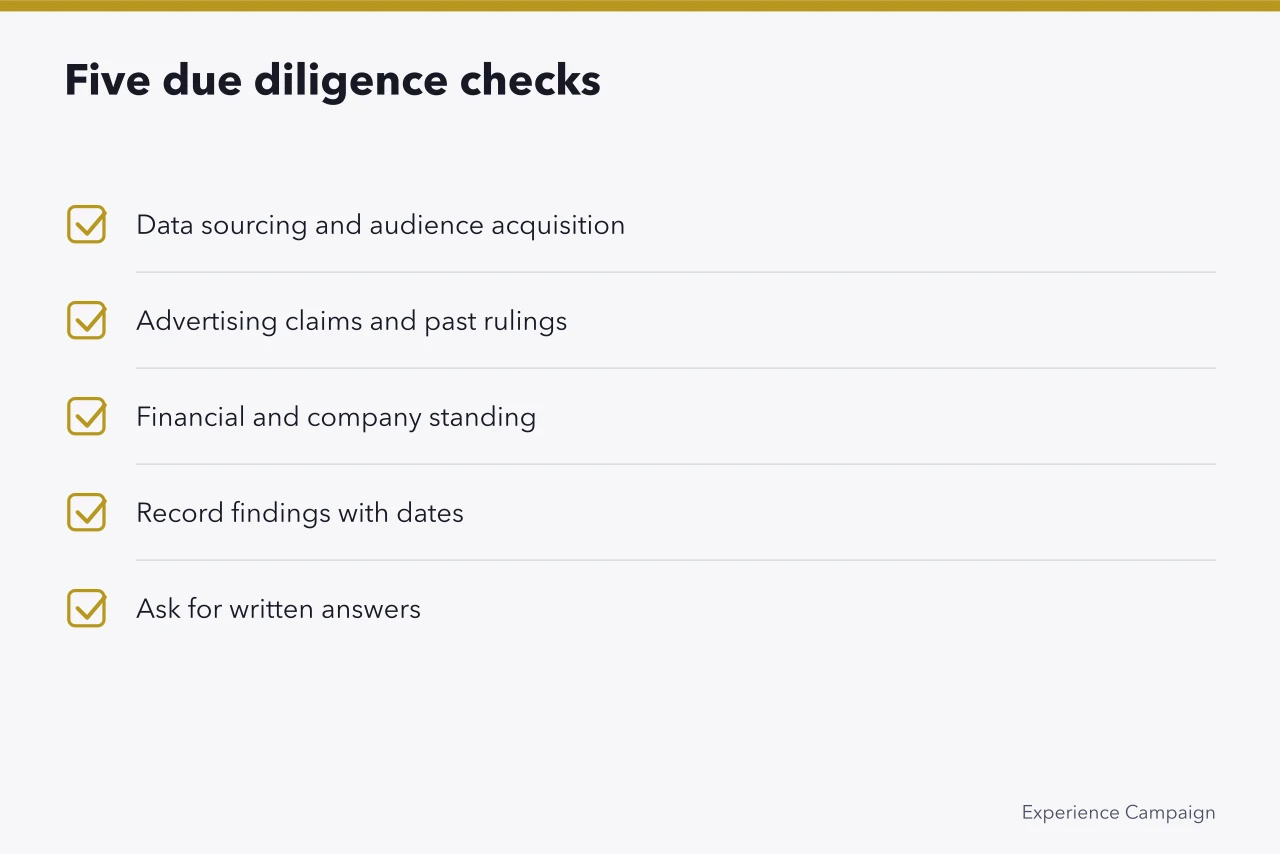
Run five checks before any agency or platform reaches your shortlist; the vendor due diligence checklist has the detail for each. First, data sourcing: ask where the contact list came from and what lawful basis covers contacting those people. The ICO says you must undertake appropriate due diligence before you use data broking services, and its guidance on sharing personal data in databases and lists says: "It is your responsibility to satisfy yourself about the integrity of the data supplied to you." That page carries the same under-review notice. Second, advertising claims: the ASA search lets you search by keyword, advertiser name or topic and narrow the results with filters, so search the agency and its trading names and record what you find, with dates. Third, financial and company standing, starting from the Companies House record. Fourth, insurance and safeguarding for live events. Fifth, measurement: ask to see a real dashboard from a comparable project.
How to compare agencies and software fairly
Agencies and software are different purchases, but the comparison logic is the same: same criteria, same evidence, same scoring scale. For example, score Supplier A, Supplier B and Supplier C on the same criteria.
Fair comparison method
- Use same criteria, evidence, scoring scale
- Score each criterion 1 to 5
- Set weightings by programme risk
- Score independently before group discussion
- Note why each score changed
Score each criterion from 1 to 5, where 3 means "meets expectation, evidenced". Reserve 5 for evidence that exceeded the brief. Anything scored 4 or 5 should have a named source in your file.
Use weightings that reflect your programme, not an industry average. A compliance-heavy financial services launch should weight data governance far above creative awards.
If you are comparing platforms rather than people, use our event marketing product comparison in England. For the step-by-step process, see our seven-step supplier comparison.
Two rules keep the process honest. First, score independently before the group discussion, so the loudest voice does not set the anchor. Second, keep a written note of why each score changed, if it changed.
Reading reviews without being misled
Vendor-written case studies are marketing. That does not make them false, but it does mean they are selected.
What the law now bans
Since 6 April 2025, the Digital Markets, Competition and Consumers Act 2024 bans fake reviews and concealed incentivised reviews, as the GOV.UK guidance on unfair commercial practices confirms for commercial practices from that date. The CMA's fake reviews guidance, dated 4 April 2025, is guidance on the prohibition under paragraph 13 of Schedule 20 to the Act. It defines a fake review as "a consumer review that purports to be, but is not, based on a person's genuine experience". The ban applies to positive and negative fake reviews alike. If a reviewer has been paid or given something free, that has to be made apparent: a trader that incentivises reviews must tell consumers that the review has been incentivised. The CMA's online consumer reviews case page reports that its website review of more than 100 businesses found that more than half, 54, could be failing to comply with its guidance. This describes the CMA's published guidance and is not legal advice, and it says nothing about what any particular supplier has done.
Tests you can apply to any review
Three review quality tests
- Does it name the criteria?
- Does it say what the supplier is bad at?
- Does it disclose how the reviewer is funded?
- Check if reviewer bought or received free
- Watch for paid placement
Look for three things in any review you read. Does it name the criteria? Does it say what the supplier is bad at? Does it disclose how the reviewer is funded?
A review that answers all three is worth more than twenty testimonials. A review that answers none of them is a brochure.
Be equally wary of review sites where suppliers can pay for placement. Paid placement is not automatically corrupting, but you deserve to know which listings are commercial.
When you read agency reviews, check whether the reviewer bought the service or received it free. Free access changes what people are willing to say.
Our round-up of event marketing agency reviews in England shows how we separate verified client feedback from supplier-supplied material, and why we publish both with labels. The general tests for how to judge agency reviews are on that page.
A worked scoring example
Suppose you are choosing an agency for a 12-city roadshow. Eventbrite's UK organiser page prints a service fee of 6.95% plus £0.59 per ticket (page captured in December 2025 and still showing that rate in October 2026). That is £3.72 on a £45 ticket, so 6,000 tickets at £45 add about £22,305 in platform fees alone, before venue hire, production, travel and paid media. Check on Eventbrite's current page whether the organiser or the buyer pays the fee and whether VAT applies before you use that total as a cost figure. Ask each supplier for a total cost for the same scope.
Item / Amount
- Ticket price (example input)
- £45.00
- Service fee, 6.95% of ticket price
- £3.13 per ticket
- Fixed fee
- £0.59 per ticket
- Total fee per ticket
- £3.72
- Total fee on 6,000 tickets
- £22,305 (£3.7175 per ticket before rounding)
Platform fees on a 6,000-ticket event at £45 are about £22,305 at Eventbrite's published UK rates, before venue, production, travel and paid media. Source: Eventbrite UK organiser page for the rates; arithmetic by Experience Campaign.
Ad hoc vs weighted scorecard
Before (ad hoc review)
- Score basis
- Star rating
- Weightings
- None
- Data compliance
- Assumed
- Ad claims
- Not checked
- Measurement
- Monthly PDF
- Cost comparison
- Day rate only
- Review cycle
- One-off decision
After (weighted scorecard)
- Score basis
- 1-5 per criterion
- Weightings
- Set by programme risk
- Data compliance
- Written answer checked
- Ad claims
- ASA search recorded
- Measurement
- Dashboard walkthrough
- Cost comparison
- Total engagement cost
- Review cycle
- Re-scored annually
Weight the criteria to match the risk. Data compliance and measurement should carry more weight than awards, because a data breach or an unmeasurable campaign costs more than a mediocre film.
| Criterion | Before (ad hoc review) | After (weighted scorecard) |
|---|---|---|
| Score basis | Star rating from a review site | 1 to 5 per criterion, evidence required for 4 or 5 |
| Weightings | None, all factors treated equally | Set by programme risk, agreed before scoring |
| Data compliance | Assumed | Written answer on lawful basis, checked against ICO guidance |
| Ad claims | Not checked | ASA search for the agency recorded with dates |
| Measurement | Monthly PDF of impressions | Dashboard walkthrough on a comparable project |
| Cost comparison | Day rate only | Total engagement cost, including data and platform fees |
| Review cycle | One-off decision | Re-scored annually or when scope changes |
Run the same table for each shortlisted supplier; the weighting method is in our product comparison guide. The numbers will not decide for you, but they will show where the trade-offs sit.
The ONS publishes UK business: activity, size and location, which counts businesses by industry and size. It can help you check whether a supplier's claimed sector experience is plausible for your market size.
Check claimed sector experience
400 companies claimed in a niche of 900 employers
Possible but worth probing
Ask for client list under NDA or a sample
For example, if an agency claims to have run events for 400 companies in a niche with 900 employers, the claim is possible but worth probing. Ask for the client list under NDA, or a sample.
Market sizing also shapes your own brief. A campaign aimed at 2,000 named buyers in one region needs different supplier skills from a national awareness push.
For a structured approach to defining who you are trying to reach, our audience research guide for England covers sampling, segment definitions and how to brief an agency with evidence rather than assumptions.
The format question changes the shortlist. A supplier that excels at large live conferences may be weaker at running a year of online sessions.
Ask how the supplier handles the join between live and online audiences. Shared registration, shared reporting and a single attendee record are the practical tests.
If the answer involves exporting spreadsheets between two systems, price the manual work into your comparison.
Many event campaigns now include paid social to drive registrations. The agency may run this, or you may keep it in house.
If the agency will run paid social, ask how it structures campaigns, audiences and reporting, and ask for examples of the reports you would receive.
Decide early who owns the ad account, the pixel and the audience data. Ownership disputes after a contract ends are common and avoidable.
Put the answer in the contract, not in a slide.
Pricing models and what to compare
Agency pricing usually falls into four shapes: project fee, retainer, day rate, or performance-linked. Each shifts risk.
Software pricing adds seat counts, event volumes and overage charges. A cheap platform can become expensive at scale.
Build one total cost line per option for the same scope. Include data purchase, platform fees, travel, venue deposits and measurement. Then compare.
If a supplier will not give a total cost range for a defined scope, treat that as a scoring risk rather than a reason to walk away immediately.
Turning the review into a repeatable process
Write the process down once and reuse it. The same scorecard, the same evidence rules, the same review cycle.
Keep a supplier file with dated notes. When a renewal comes round, you will have a record rather than a memory.
Our directory of event marketing best providers in England is organised so you can filter by service type and region, then apply your own scorecard to the shortlist rather than ours.
Review the scorecard itself once a year. Criteria that mattered for a 2024 launch may be irrelevant for a 2027 programme.
Common questions
How many reviews should I read before shortlisting?
Enough to cover each shortlisted supplier from at least two independent angles, such as a client reference and a published case study. Three to five suppliers is usually workable. More than that and the scoring quality drops.
Can I rely on review sites with star ratings?
Only as a starting filter. Use them to build a longlist, then run your own weighted scorecard before any decision.
What should I ask an agency about audience data?
Ask for the source of the data, the lawful basis for contact, and whether consent was collected directly. The ICO's guidance says due diligence is required before use, though the guidance is under review, so check the current text.
How often should a supplier review be repeated?
At least annually, and whenever the scope changes materially, such as adding a new region or moving from live to hybrid delivery. Dated notes make the re-score quick.
Methodology
The legal and fee figures in this guide come from official and primary pages: the CMA's fake reviews guidance dated 4 April 2025, the CMA's online consumer reviews case page (last updated 27 March 2026), GOV.UK's unfair commercial practices guidance, the ICO's data broker and data sharing pages, the ASA's search page, and Eventbrite's UK organiser page. We checked each quotation against the text of the page it cites in October 2026. The ICO and ASA pages print no date, and the Eventbrite rate was printed on the page when we captured it in December 2025 and was still printed there in October 2026, so check the current rate before you budget. The £22,305 total is our own arithmetic on an example event, not a quoted price. We read other published supplier guides only to see what they leave out; none is used as a source.
Cite this
Experience Campaign (2026). "How to assess event marketing suppliers". https://experiencecampaign.co.uk/event-marketing-reviews-and-comparison-methods-for-2027
In this guide
- Checks to run before you shortlist event marketing agencies and platformsA due diligence checklist for English buyers: the checks and red flags to apply before shortlisting event marketing providers, with a before and after table.
- 3 weighted criteria to score event marketing products against your briefHow agencies in England can score event marketing products on three weighted criteria: cost per registration, data ownership and audience fit.
- Where do event marketing agency reviews come from and can you trust them?How to judge event marketing agency reviews, what this method assesses, what it leaves to vendor claims, and how to keep a dated evidence trail.
- Event marketing selection checklist: evidence to request by event typeAn event marketing selection checklist for England: the evidence to request from an agency for a ticketed consumer, political or corporate delegate event.