

Rules and ethics
Event marketing agency after Brexit: EU suppliers and data
How a UK event marketing agency buying from EU suppliers handles the VAT reverse charge and ICO transfer tools for attendee data after Brexit.
What to take away
- Since 1 January 2021 the UK sits outside the EU VAT area, so a UK agency buying from EU suppliers follows UK rules on services received from overseas.
- UK agencies buying in services from EU suppliers must self-account for VAT under the reverse charge.
- An EU supplier's quote can look cheaper because no foreign VAT is added, yet the agency still owes UK VAT on the purchase.
- Event attendee data sent outside the UK needs an ICO transfer tool, such as an adequacy finding, the IDTA or the UK Addendum.
- For every EU supplier or processor, keep the VAT number evidence, a valid invoice, a clear record of the service and the transfer assessment on file.
What changed for UK agencies buying from the EU
Leaving the EU changed both the VAT rules and the data rules for UK agencies that buy from EU partners. The old EU framework no longer applies to the UK, and the agency now has to apply UK rules to its purchases and its data flows.
Since 1 January 2021, the UK has been outside the EU VAT area, and the Mini One Stop Shop that HMRC operated for UK businesses closed. Before 2021 that scheme was limited to certain business-to-consumer supplies, and it never covered cross-border event services billed to business customers.
Data rules diverged as well. The UK operates its own UK GDPR and can make adequacy findings independently of the EU. For event campaigns that move attendee data to a processor or group company outside the UK, the agency needs a valid transfer mechanism under UK rules, not the old EU framework.
Which side of the reverse charge are you on?
Place of supply decides the side. For business-to-business services it is generally where the customer belongs, so a UK agency selling to an EU business charges no UK VAT, while a UK agency buying from an EU supplier accounts for UK VAT itself.
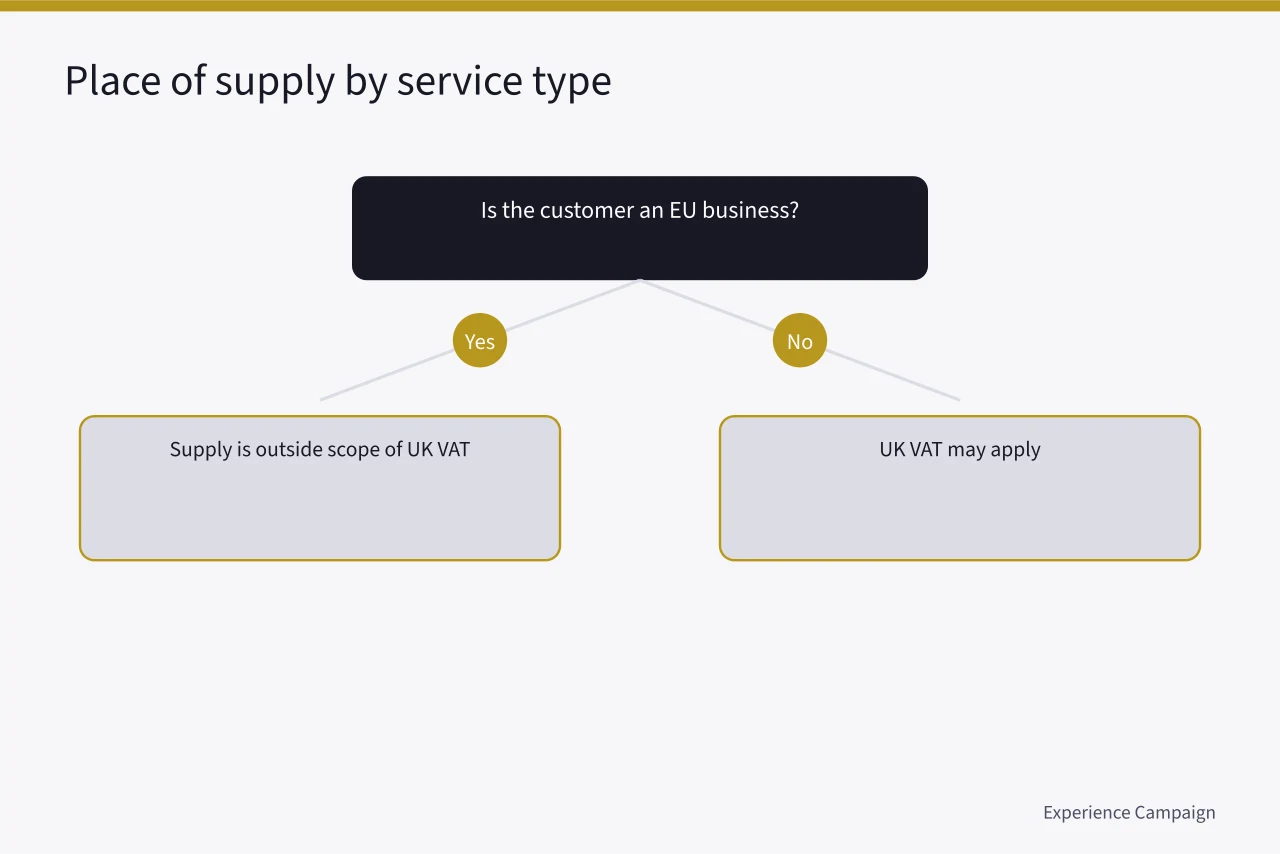
A UK agency should check each service line rather than applying one rule to the whole job. Design work, stand build, staffing, digital campaigns and venue-related services can fall under different place-of-supply rules. VAT Notice 741A is the reference point for those distinctions.
Some services have special rules. Services connected with land, such as stand space at a venue, follow the place where the land is. Admission to an event is treated separately too, and the exact treatment depends on who is buying and what is supplied.
Selling to consumers changes the position again. A UK agency supplying digital or event-related services to an EU consumer may need to register and account for VAT in the customer's country, or use the non-union One Stop Shop where eligible. That scheme is open to businesses not established in the EU, and registration is made with an EU tax authority rather than HMRC.
Reverse charge on services received from EU suppliers
When a UK agency buys services from an EU supplier, the reverse charge for services received from overseas applies. The agency accounts for UK VAT on the purchase in its UK VAT return, usually as output tax and input tax at the same time, subject to recovery rules.
This matters for cost planning. An EU supplier's fee may look lower because no foreign VAT is added, but the UK agency still has to account for UK VAT on the reverse charge. Cash flow and partial exemption can affect how much is recoverable.
Pricing models need to reflect this. A retainer, a project fee and a performance fee can each sit in a different place for VAT and cash-flow purposes. UK agencies that set event marketing costs without factoring in reverse charge mechanics can misprice EU work.
Where a UK agency uses an EU subcontractor for stand build or staffing, the same reverse charge logic applies. The agency needs the supplier's VAT number, a valid invoice and a clear record of the service. Without those, input tax recovery can be challenged.
Compare how each supplier structures its quote before you accept a net figure. The event marketing pricing models show whether fees are quoted net or inclusive of tax, which tells you whether the EU quote is really the cheaper one.
Where the budget goes wrong on EU purchases
Most budget errors on EU purchases come from treating the supplier's headline fee as the final cost. The quote leaves out the UK VAT the agency owes through the reverse charge, and the agency may not recover all of it.
A second error is applying one rule to a whole contract. Stand space, staffing and design can each be treated differently, so a single assumption can be wrong for several lines at once.
A third is a thin paper trail. If the supplier's VAT number, invoice and service record are missing, the agency cannot show why it treated a purchase as it did, and it may struggle to defend a recovery claim.
Checking an EU supplier's VAT number and invoice
Check the supplier before you pay the first invoice. EU VAT numbers can be checked through VIES, the EU's VAT number validation service, and UK VAT numbers through HMRC's Check a UK VAT number service. Keep a dated copy of the result with the supplier file.
| Item to hold | Where it comes from | What it supports |
|---|---|---|
| Supplier VAT number | The supplier, checked through VIES for EU numbers | Evidence of who you are buying from |
| Valid invoice | The supplier | Input tax recovery |
| Record of the service | Your contract or brief | A clear description of what was supplied |
| Reverse charge entry | Your own VAT return | Output tax and input tax shown together |
HMRC expects a UK supplier to hold evidence that its customer is a business, and the same discipline applies in reverse. A missing VAT number, invoice or service record is the paperwork gap that lets input tax recovery be challenged on a cross-border job.
ICO transfer tools for event attendee data
Attendee data needs a lawful route out of the UK. Event data often moves across borders through registration lists, badge scans, app analytics and CRM records, and the ICO's international transfers guidance sets out the tools that make those transfers lawful under UK GDPR.
An adequacy finding is the simplest route. If the destination country has UK adequacy regulations, information can flow freely from the UK without any additional safeguard. The UK has its own adequacy list, which does not automatically mirror the EU's.
The International Data Transfer Agreement, or IDTA, is the UK's standard contractual tool for transfers to countries without adequacy. It replaced the old EU standard contractual clauses for UK transfers. Check each platform's contract to see which route it offers.
The UK Addendum is used when an organisation wants to rely on the EU standard contractual clauses for UK transfers. It amends those clauses so they work under UK law. Many event platforms offer the EU clauses plus the UK Addendum as their standard package.
A transfer risk assessment is part of the process. The ICO expects organisations to assess the risks in the destination country and to put extra measures in place where needed. For event data, that means looking at who can access the data and for what purpose.
UK GDPR obligations apply to event data moved across borders, including the principles, lawful bases and individual rights. Event marketing data protection depends on having those rules written down and followed by every supplier on the job.
Questions to put to each EU supplier
Put the same short list of questions to every supplier before signing, so the answers can be compared and filed. The list below covers both the VAT side and the data side of the relationship.
- Which VAT number will appear on the invoice, and can it be checked through VIES?
- Is the quoted fee net of VAT, and is it fixed or an estimate?
- Which services will you subcontract, and to whom?
- Where will attendee data be stored, and who can access it?
- Which transfer route does your contract use for UK dataadequacy, the IDTA or the UK Addendum?
- Can you share the contract terms that cover data return and deletion at the end of the job?
A supplier that cannot answer these cleanly is telling you something about how it will handle the job itself.
Choosing a transfer tool by destination
The right tool depends on the destination and on what the platform offers. Match each flow of attendee data to a row in the table, and record the choice beside the contract so the reason is on file if anyone asks.
| Situation | Tool | What to record |
|---|---|---|
| Destination has UK adequacy regulations | The adequacy finding | The destination and its adequacy status |
| No adequacy, contract on UK terms | The IDTA | The signed agreement and the risk assessment |
| Platform offers EU clauses as standard | EU standard contractual clauses plus the UK Addendum | Both documents and the risk assessment |
| Any safeguard relied on | Transfer risk assessment | Who can access the data and for what purpose |
Whatever the row, start with a map. Map where attendee data goes, check the destination country's status, put the right tool in place and record the decision. For a global event campaign, that map may cover several countries and several vendors.
Worked example: the buying side of one exhibitor contract
A Manchester-based agency serves a German exhibitor at a UK trade show, and its own purchases follow six steps. Each step applies to a supplier the agency buys from, not to the exhibitor it invoices.
Six steps for a UK agency
- Check the customer's EU VAT number
- Apply place-of-supply rules per service line
- Separate the land-related stand space element
- Handle reverse charge on EU purchases
- Check the data transfer route
- Record the decisions and evidence
- List every EU supplier on the job. The agency buys translation and copywriting services from a Dutch supplier.
- Check the supplier's VAT number through VIES and keep the evidence on file.
- Hold a valid invoice and a clear record of the service.
- Account for UK VAT on the purchase under the reverse charge in the UK VAT return, subject to recovery.
- Check the data route. The follow-up campaign sends attendee data to a CRM hosted in the United States, so the agency checks the destination's adequacy status and, if needed, puts an IDTA in place with the platform.
- Record the decisionsthe VAT number evidence, the invoice, the transfer assessment and the contract terms.
Hospitality is the other cost to plan. HMRC's guidance on expenses and benefits for entertainment explains when client and staff entertaining is treated as a taxable benefit, which matters for event hospitality budgets. The treatment depends on who is entertained and why.
A checklist for the next EU supplier:
- Verify each EU supplier's VAT number and keep the evidence.
- Hold a valid invoice and a clear record of each service.
- Account for UK VAT on EU purchases under the reverse charge.
- Map attendee data flows and put an ICO transfer tool in place where needed.
- Record the transfer risk assessment and the contract terms.
Notices and guidance to keep to hand
Three HMRC notices and one ICO guide cover this ground. VAT Notice 741A explains the place of supply of services, VAT Notice 700/1 covers when a UK agency must register for VAT, and VAT Notice 700, The VAT Guide, is the general reference for invoicing, records and returns.
How to account for VAT on services bought from overseas suppliers, including the reverse charge, sits in HMRC's place-of-supply guidance in VAT Notice 741A. The ICO's international transfers guidance is the data-side reference, covering adequacy, the IDTA, the UK Addendum and transfer risk assessments.
For commercial and pricing conduct, the CMA publishes guidance on unfair terms and competition rules. It is relevant when an agency drafts cross-border contracts or sets prices with EU partners.
For the wider picture, read how UK regulations for event marketing fit together. Before taking on a new EU client, work through how to brief an event marketing agency so supplier roles are clear from the start.
Common questions
Did the Mini One Stop Shop cover these services?
No. The scheme was limited to certain business-to-consumer supplies and never covered event services billed to business customers. The scheme that HMRC operated for UK businesses closed after the UK left the EU VAT area.
What if I buy services from an EU supplier?
You self-account for the VAT through the reverse charge. The entry goes on your own return, normally as output tax and input tax together, and how much you can recover depends on the recovery rules.
How do I check an EU VAT number?
Use VIES, the EU's VAT number validation service. UK VAT numbers can be checked through HMRC's Check a UK VAT number service. Keep the evidence with the supplier file.
Which ICO tool do I need for event data?
It depends on the destination. An adequacy finding needs no extra tool. Otherwise the IDTA, or the EU standard contractual clauses with the UK Addendum, is the usual route. A transfer risk assessment supports the decision.
Where do I check a UK agency or supplier?
The Companies House register shows company status, filing history and directors. It is the public record for verifying a UK business before contracting.
Does the CAP Code apply to cross-border event campaigns?
Yes, for advertising that falls within UK jurisdiction. The ASA administers the CAP Code, and agencies should check claims and promotions against it.